Mastering The Technique: How To Do Partial Quotients
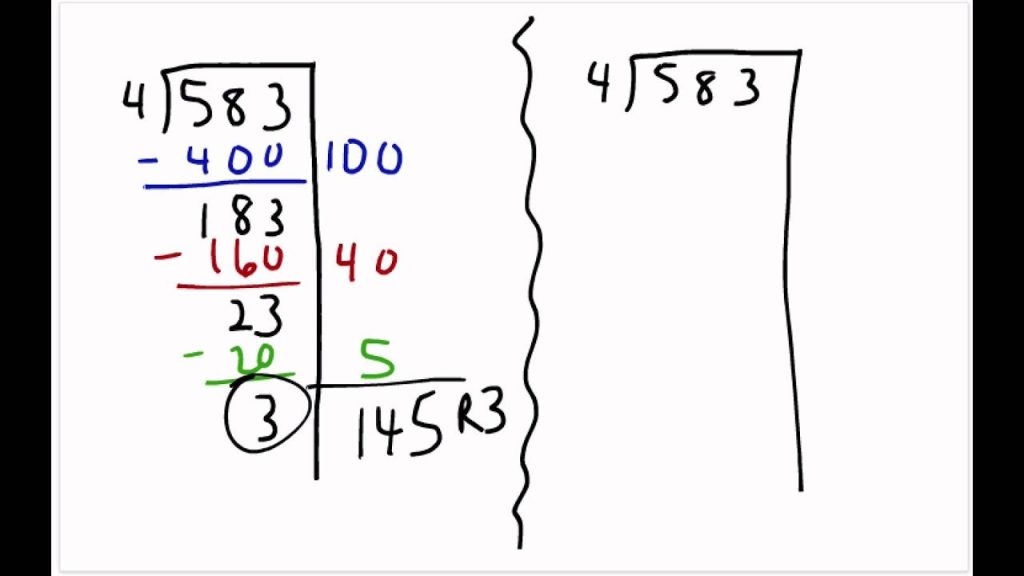
Dividing large numbers can be daunting, but fear not! Partial quotients offer a simple and effective method to tackle long division problems with ease. Instead of relying solely on memorized steps, this approach encourages understanding and flexibility in solving mathematical equations. By breaking down the division process into manageable parts, ‘how to do partial quotients’ empowers learners to confidently navigate complex calculations. Let’s delve into this technique step by step for a clearer grasp on division mastery.

How to Do Partial Quotients: A Step-by-Step Guide for Easy Division
Division can sometimes be tricky, especially when dealing with larger numbers. But fear not, because partial quotients can make division a whole lot easier! In this guide, we will walk you through the process of using partial quotients to solve division problems step by step. By the end of this article, you’ll be a pro at dividing numbers using this method.
What are Partial Quotients?
Partial quotients is a division strategy that involves breaking down a division problem into smaller, more manageable parts. Instead of trying to divide the entire number at once, you divide it in chunks, making the process less overwhelming and easier to follow. This method is particularly helpful when dealing with large numbers or complex division problems.
Step 1: Set Up Your Problem
Before diving into the division process, the first step is to set up your problem. Write down the dividend (the number being divided) and the divisor (the number you are dividing by) in the form of a long division problem. For example, let’s say you want to divide 256 by 4. Your setup would look like this:
4 | 256
Step 2: Start with the Largest Multiple
The next step is to identify the largest multiple of the divisor that is less than or equal to the dividend. In our example, the largest multiple of 4 that is less than 256 is 60 (4 x 60 = 240). Write this number above the dividend and subtract it from the dividend to find the remainder:
4 | 256
60
-240
The remainder after subtracting 240 from 256 is 16.
Step 3: Repeat the Process
Now, we’ll repeat the process with the remainder. Look for the next multiple of the divisor that is less than the remainder. In this case, the next multiple of 4 that fits is 4 (4 x 4 = 16). Write 4 above the 16 (remainder) and subtract to find the new remainder:
4 | 256
60
-240
4
-16
The new remainder is 0, which means we have successfully divided 256 by 4 using partial quotients. The quotient is the sum of all the numbers written above the dividend (60 + 4 = 64).
Step 4: Check Your Answer
Always double-check your division using partial quotients by multiplying the quotient by the divisor and adding the remainder. In our example, 64 (quotient) x 4 (divisor) + 0 (remainder) should equal 256 (dividend). This step is crucial to ensure you have divided the numbers correctly.
Advantages of Using Partial Quotients
Partial quotients offer several advantages when it comes to division. Firstly, it simplifies the division process by breaking down the problem into smaller steps, making it easier to follow and understand. This method also encourages critical thinking and reinforces the concept of division as repeated subtraction, helping students grasp the fundamental principles of division.
Practice Makes Perfect
Like any new skill, mastering partial quotients requires practice. The more you practice using this division strategy, the more proficient you will become at dividing larger numbers with ease. So, grab a pencil and paper and start practicing your partial quotients today!
With these simple steps and a bit of practice, you can become a division pro using the partial quotients method. Remember to take your time, follow each step carefully, and double-check your answers. Division doesn’t have to be daunting, especially when you have the handy tool of partial quotients at your disposal.
So, go ahead, give partial quotients a try, and watch how it transforms the way you approach division problems!
Math Antics – Division With Partial Quotients
Frequently Asked Questions
How do I use partial quotients to divide larger numbers?
To use partial quotients method for division, first, write the dividend on the left and the divisor on the right. Then, estimate how many times the divisor can go into the first digit or group of digits of the dividend. Subtract this estimate from the dividend to get a new number. Repeat the process with this new number until you have divided all digits.
What should I do if the remaining number in partial quotients is smaller than the divisor?
If the remaining number is smaller than the divisor, you can put a decimal point in the dividend and add zeros to continue the division process. Keep adding zeros as needed until you have enough decimal places for the quotient.
Can partial quotients method be used for dividing decimals?
Yes, partial quotients method can be used for dividing decimals. Treat the decimal number as a whole number by moving the decimal point to the right. Proceed with the division using the partial quotients method as usual and at the end, adjust the decimal point location in the quotient.
Final Thoughts
In conclusion, mastering how to do partial quotients is a valuable skill in long division. Begin by breaking down the dividend into smaller, manageable chunks. Next, repeatedly subtract multiples of the divisor until you obtain the quotient. Remember to keep track of your remainders to ensure accuracy throughout the process. With practice, using the partial quotients method will become more efficient and intuitive. Happy dividing!