Electric vs. Manual Loft Ladders: Which Is Worth the Investment?
Explore the pros and cons of electric and manual loft ladders to find the best fit for your needs.
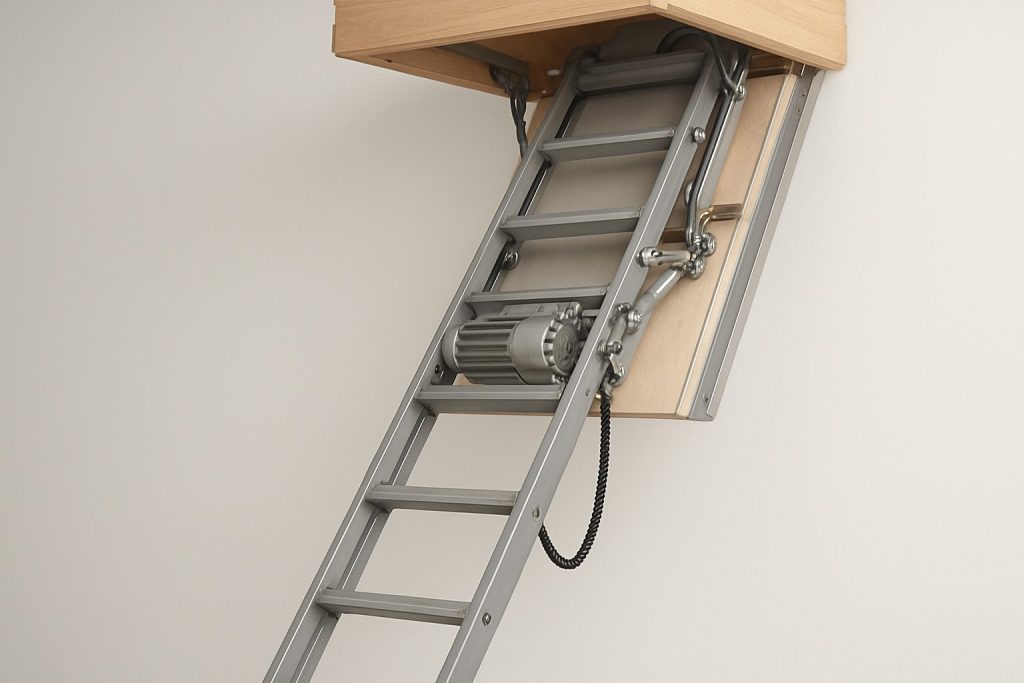
The choice between an electric and a manual Loft Ladder is one that most homeowners resolve quickly by looking at price. But cost alone is an incomplete basis for the decision. Electric loft ladders address specific problems that manual models cannot fully solve—and for the right household, the investment case is stronger than it first appears.
What Distinguishes an Electric Loft Ladder from a Manual One?
A manual loft ladder is deployed and retracted by hand, either via a pull cord, a pole, or by direct handling of the hatch. An electric model uses a motorised mechanism—controlled by a wall switch or remote—to lower and raise the ladder automatically.
The key practical differences:
Who Benefits Most from an Electric Loft Ladder?
An electric loft ladder is most valuable in specific circumstances:
Households with older adults or mobility limitations – Motorised deployment eliminates the need to grip, pull, or manage a heavy hatch door manually
High-ceiling properties – Manual deployment of a four-section ladder at 3.5 m ceiling height is physically demanding; motorised systems remove this difficulty
Very frequent attic access – When the loft is used daily or near-daily, the reduced physical effort compounds to meaningful benefit over time
Users who regularly carry items up – A motorised system can be paused at partial deployment to allow hands-free step access
For a fit adult accessing a standard-height loft once or twice a week, the additional cost of an electric system is harder to justify on purely practical grounds.
What Are the Limitations of Electric Loft Ladders?
Higher capability comes with trade-offs:
Power dependency – An electric ladder requires a mains connection to function. A blown fuse or power cut leaves the system non-operational unless a manual override is included
Installation cost – Professional installation, including electrical connection, adds £150–£400 to the total project cost in most cases
Maintenance complexity – Motor components and control systems require periodic servicing and may incur repair costs beyond those of a standard mechanical ladder
Hatch size requirements – Some electric systems require a larger hatch opening than standard manual models
What Should You Look for in an Electric Loft Ladder System?
If you decide an electric system is appropriate, evaluate:
Manual override – An essential safety feature allowing manual deployment in the event of power failure
Safety sensors – Some systems detect obstruction during deployment and stop automatically to prevent injury
Load rating – Confirm the motor mechanism is rated for the expected user weight; electric systems range from 150 kg to 200 kg in standard residential models
Noise level – Motor operation can be surprisingly loud on cheaper units; check decibel ratings where available
Warranty coverage – Given the motor and electrical components, a minimum three-year warranty is a reasonable expectation for a quality system
What Does the Total Cost Comparison Look Like?
For a standard ceiling height installation:
Quality manual system (installed): £150–£600 total
Quality electric system (installed, including electrical connection): £900–£2,500 total
At a 15-year lifespan, the cost differential per year is approximately £50–£130. For households where the electric system addresses a genuine